

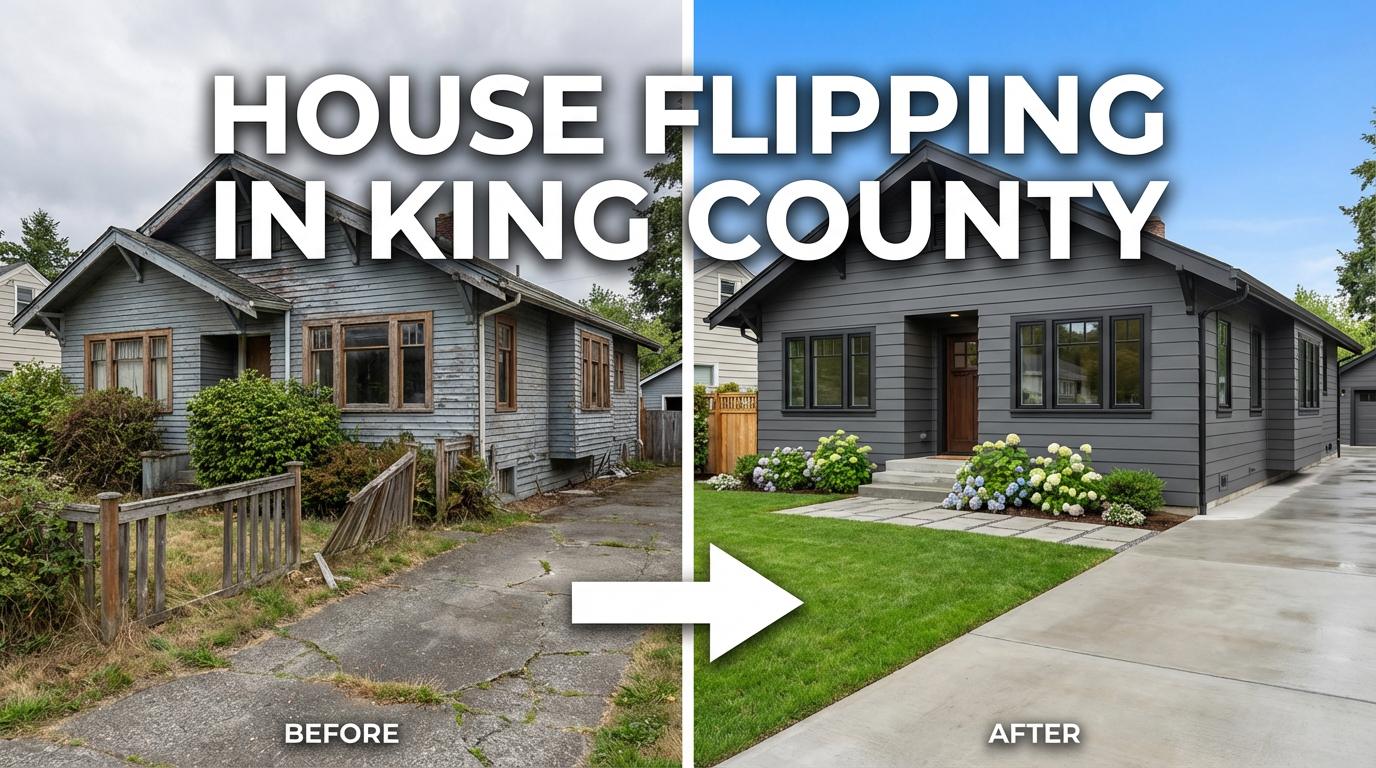
Flipping Houses in King County: Complete 2026 Investment Guide for Tech Professionals
House flipping in King County, Washington, presents unique opportunities for tech professionals looking to diversify their investment portfolios beyond stocks and equity compensation. With a median home price of $795,000 as of February 2026 and an average gross profit of $65,000-$134,329 per flip, the Seattle area market offers substantial returns for investors who understand local dynamics, renovation costs, and buyer preferences.
This comprehensive guide explores house flipping in King County from the perspective of tech professionals entering real estate investment, covering market analysis, financing strategies, renovation approaches, and profit maximization techniques specific to the Greater Seattle area.
Understanding the King County Flipping Market in 2026
The King County house flipping market in 2026 is characterized by moderate activity, stable pricing, and opportunities for strategic investors. Unlike the frenzied markets of 2020-2022, today's environment rewards careful analysis, quality renovations, and realistic pricing.
Current Market Metrics
- Flip Rate: Seattle's home-flipping rate is 5.5% of all home sales (Q1 2026), lower than many U.S. markets, indicating less competition but also suggesting a more discerning buyer base.
- Average Gross Profit: $65,000-$134,329 per flip nationally and in Washington State, with Seattle potentially higher due to elevated home prices.
- Average ROI: 20-30% gross profit margin is typical, though this varies significantly by property type, location, and renovation scope.
- Time to Flip: Average of 166 days from purchase to sale, including acquisition, renovation, and marketing time.
- Median Home Price: $795,000 in King County (down 0.62% YoY), providing a baseline for flip valuations.
- Days on Market: 58 days average, giving flippers time to market properties effectively.
Why King County for House Flipping?
King County offers several advantages for house flippers:
- Strong Economic Fundamentals: Tech industry stability ensures consistent buyer demand, particularly from high-income professionals.
- Limited Geography: Water and mountains constrain supply, supporting long-term appreciation and reducing risk of oversupply.
- Diverse Neighborhoods: From urban Seattle to suburban Bellevue and Redmond, multiple markets cater to different buyer segments and price points.
- High-Income Buyers: Tech professionals with substantial compensation seek move-in-ready homes, willing to pay premiums for quality renovations.
- Appreciation History: King County has historically appreciated 6-7% annually over 20 years, providing a safety net for longer holds.
Challenges to Consider
- High Entry Costs: With median prices near $800K, flippers need substantial capital or financing.
- Elevated Renovation Costs: Seattle-area labor and materials are expensive, with average renovation costs reaching $52,000+.
- Permit Requirements: King County and Seattle have strict permitting and inspection requirements, adding time and cost.
- Competitive Buyer Market: Seattle buyers are sophisticated and selective, demanding high-quality finishes and modern amenities.
- Property Taxes: At 0.92% average, property taxes during the flip period can be substantial.
The House Flipping Process: Step-by-Step
Step 1: Market Research and Target Selection
Successful flipping begins with thorough market research. Identify neighborhoods with:
- Strong Buyer Demand: Areas near tech employers, good schools, and amenities attract buyers quickly.
- Price Appreciation: Neighborhoods showing consistent appreciation provide safety margins.
- Renovation Potential: Look for areas where updated homes command significant premiums over dated properties.
- Inventory Turnover: Neighborhoods with reasonable days-on-market (30-60 days) indicate healthy demand.
Best King County Neighborhoods for Flipping (2026):
- Renton: More affordable entry point ($600K-$750K), strong rental demand if flip takes longer, proximity to Boeing and tech employers.
- Bothell: Growing area with good schools, median prices $850K-$1M, strong family buyer demand.
- West Seattle: Neighborhood feel within Seattle, median $850K-$1.05M, strong community identity attracts buyers.
- Columbia City: Transit-oriented, gentrifying neighborhood, median $700K-$900K, younger buyer demographic.
- Beacon Hill: Affordable Seattle option, light rail access, median $650K-$850K, strong appreciation potential.
- North Renton: Proximity to Bellevue and Seattle, median $700K-$900K, professional buyer base.
- Shoreline: Good schools, family-friendly, median $750K-$950K, stable demand.
Avoid or Approach with Caution:
- Ultra-premium neighborhoods (Medina, Clyde Hill, Mercer Island) where buyers expect custom quality and have specific tastes
- Areas with declining employment or school ratings
- Neighborhoods with high inventory and slow sales
- Properties requiring foundation or major structural work unless you have deep experience
Step 2: Finding Properties to Flip
Sourcing the right property at the right price is critical. Tech professionals can leverage their analytical skills and networks:
MLS Search Strategies:
- Filter for properties listed 60+ days (motivated sellers)
- Search for keywords: "fixer," "TLC," "investor special," "handyman special"
- Look for estate sales, probate properties, and divorce situations
- Target properties priced 15-25% below neighborhood median
- Focus on homes with dated kitchens, bathrooms, or cosmetic issues rather than structural problems
Off-Market Opportunities:
- Direct Mail Campaigns: Target absentee owners, pre-foreclosures, and high-equity homeowners in desired neighborhoods
- Networking: Connect with real estate agents, wholesalers, and other investors for off-market deals
- Foreclosure Auctions: King County holds foreclosure auctions, though competition can be intense
- Probate Court: Monitor probate filings for estate properties that heirs may want to sell quickly
- Driving for Dollars: Identify distressed properties in target neighborhoods and contact owners directly
Wholesalers and Bird Dogs:
Build relationships with property wholesalers who find deals and assign contracts for fees. While you'll pay a premium (typically $10K-$30K), wholesalers can provide deal flow without extensive searching.
Step 3: Analyzing Deals with the 70% Rule
The 70% Rule is the foundation of flip analysis: Never pay more than 70% of the After-Repair Value (ARV) minus renovation costs.
Formula: Maximum Purchase Price = (ARV × 70%) – Renovation Costs
Example:
- ARV (comparable sales of renovated homes): $950,000
- Estimated renovation costs: $75,000
- Maximum purchase price: ($950,000 × 70%) – $75,000 = $665,000 – $75,000 = $590,000
This formula accounts for:
- Holding costs (mortgage interest, property taxes, insurance, utilities)
- Selling costs (6% realtor commission, closing costs, staging)
- Unexpected expenses (10-20% contingency)
- Desired profit margin
Calculating ARV:
Research comparable sales (comps) of recently renovated homes in the same neighborhood. Look for:
- Sales within the last 3-6 months
- Similar square footage (within 10-15%)
- Same number of bedrooms and bathrooms
- Similar lot size and features
- Comparable condition and finishes
Use at least 3-5 comps and average their sale prices, adjusting for differences in size, features, and location.
Step 4: Conducting Due Diligence
Before purchasing, conduct thorough due diligence:
Professional Home Inspection ($400-$600):
- Identify major issues: foundation, roof, electrical, plumbing
- Estimate repair costs accurately
- Uncover hidden problems that could derail the flip
- 86% of inspections reveal at least one issue—use findings to negotiate price
Specialized Inspections:
- Sewer Scope ($200-$300): Essential for older homes; sewer line replacement can cost $10K-$20K
- Structural Engineer ($500-$1,000): For any foundation or structural concerns
- Pest Inspection ($100-$200): Check for termites, carpenter ants, rodents
- Mold Inspection ($300-$500): If moisture issues are suspected
Title and Liens:
- Verify clear title with no unexpected liens or encumbrances
- Check for unpaid property taxes, HOA dues, or contractor liens
- Review property history for red flags
Permit History:
- Research past permits and verify work was completed legally
- Unpermitted work can complicate sales and require expensive corrections
- Check for open permits that need closure
Step 5: Financing Your Flip
Tech professionals have several financing options, each with trade-offs:
1. Cash Purchase (Best ROI)
- Pros: No interest costs, faster closing, stronger negotiating position, maximum profit
- Cons: Ties up significant capital, limits ability to do multiple flips simultaneously
- Best For: Tech professionals with substantial liquid assets or vested RSUs
2. Hard Money Loans
- Terms: 12-18% interest, 1-3 points upfront, 6-12 month terms
- Loan-to-Value: Typically 70-80% of purchase price, sometimes 100% of purchase + renovation
- Pros: Fast approval (days), based on property value not credit, allows leverage
- Cons: Expensive, short terms create pressure, requires exit strategy
- Best For: Experienced flippers who can complete projects quickly
3. Private Money Lenders
- Terms: 8-10% interest, negotiable terms, relationship-based
- Pros: More flexible than hard money, potentially better terms, can structure creatively
- Cons: Requires finding and vetting lenders, personal relationships at stake
- Best For: Tech professionals with high-net-worth connections willing to invest
4. Cash-Out Refinance or HELOC
- Terms: 6-8% interest, based on primary residence equity
- Pros: Lower interest than hard money, longer terms, tax-deductible interest
- Cons: Puts primary residence at risk, requires significant home equity
- Best For: Homeowners with substantial equity and stable income
5. Fix-and-Flip Loans (Rehab Loans)
- Terms: 7-12% interest, covers purchase + renovation, draws released as work completes
- Pros: Single loan for entire project, structured for flipping, renovation oversight
- Cons: More expensive than conventional loans, requires detailed renovation plans
- Best For: First-time flippers who want structured financing
6. Partnerships
- Structure: Partner provides capital, you provide expertise and labor; split profits 50/50 or negotiate
- Pros: No debt, shared risk, access to more capital
- Cons: Shared profits, potential for disagreements, requires clear agreements
- Best For: Tech professionals with limited capital but strong project management skills
Step 6: Planning and Executing Renovations
Renovation strategy determines profitability. Focus on improvements that maximize ARV while controlling costs.
High-ROI Renovations for King County:
1. Kitchen Remodel (ROI: 70-80%)
- Budget: $25,000-$45,000 for mid-range; $50,000-$75,000 for high-end
- Focus: White or gray cabinets, quartz countertops, stainless appliances, subway tile backsplash
- Seattle Buyers Expect: Open concept, large island, quality appliances, modern lighting
- Cost-Saving Tips: Reface cabinets instead of replacing if boxes are solid; use stock cabinets with custom fronts
2. Bathroom Remodel (ROI: 60-70%)
- Budget: $15,000-$25,000 per bathroom
- Focus: Modern vanities, frameless glass showers, large-format tile, quality fixtures
- Seattle Buyers Expect: Spa-like primary bathrooms, double vanities, walk-in showers
- Cost-Saving Tips: Keep plumbing in place to avoid expensive relocations; use affordable tile with high-end look
3. Flooring (ROI: 50-60%)
- Budget: $5-$12 per square foot installed
- Focus: Luxury vinyl plank (LVP) or engineered hardwood in living areas; tile in wet areas
- Seattle Buyers Expect: Consistent flooring throughout main level, no carpet in living areas
- Cost-Saving Tips: LVP offers hardwood look at fraction of cost; avoid exotic woods
4. Paint and Finishes (ROI: 100%+)
- Budget: $3,000-$6,000 for whole house
- Focus: Neutral grays and whites, quality paint, updated light fixtures and hardware
- Seattle Buyers Expect: Fresh, modern colors; no bold or dated choices
- Cost-Saving Tips: DIY if skilled; use mid-grade paint (Sherwin-Williams or Benjamin Moore)
5. Curb Appeal (ROI: 80-100%)
- Budget: $3,000-$8,000
- Focus: Landscaping, new front door, exterior paint touch-up, modern house numbers
- Seattle Buyers Expect: Well-maintained exterior, inviting entry, native landscaping
- Cost-Saving Tips: Focus on front yard; simple, clean landscaping beats elaborate designs
6. Open Floor Plan (ROI: 60-80%)
- Budget: $5,000-$15,000 depending on walls removed
- Focus: Remove walls between kitchen and living areas (if not load-bearing)
- Seattle Buyers Expect: Open, flowing spaces for entertaining
- Cost-Saving Tips: Consult structural engineer before removing walls; some walls can be partially removed with beams
Renovations to Avoid:
- Pools: Expensive to install and maintain; many Seattle buyers see them as liabilities
- Overly Personal Features: Unique tile patterns, bold colors, or niche amenities limit buyer appeal
- Luxury Upgrades in Mid-Range Neighborhoods: Don't over-improve for the area
- Extensive Landscaping: Keep it simple and maintainable
- High-End Appliances in Entry-Level Homes: Match finishes to price point
Renovation Timeline and Management:
Efficient project management minimizes holding costs:
- Week 1-2: Demolition, structural work, rough plumbing/electrical
- Week 3-4: Framing, drywall, HVAC installation
- Week 5-6: Flooring, cabinets, countertops
- Week 7-8: Painting, fixtures, trim work
- Week 9-10: Final touches, cleaning, staging
Total renovation time: 8-12 weeks for typical flip. Delays add holding costs of $3,000-$5,000 per month.
Contractor Management:
- Get 3+ bids for major work; check licenses, insurance, and references
- Use detailed contracts with payment schedules tied to milestones
- Visit the site daily or hire a project manager
- Build contingency time into schedule for delays
- Maintain good relationships for future projects
Step 7: Staging and Marketing
Professional staging and marketing maximize sale price and speed:
Staging ($2,000-$5,000):
- Staged homes sell 73% faster and for 5-10% more than unstaged homes
- Focus on living room, kitchen, primary bedroom, and primary bathroom
- Use neutral, modern furniture that appeals to Seattle's tech-savvy buyers
- Highlight home office spaces—critical for remote workers
Professional Photography ($300-$600):
- High-quality photos are essential for online listings
- Include drone shots for properties with views or large lots
- Twilight photos create emotional appeal
- Virtual tours and 3D walkthroughs attract serious buyers
Listing Strategy:
- Price competitively based on current comps, not your costs
- List on MLS for maximum exposure
- Time listing for spring/summer when buyer activity peaks
- Host open houses on weekends
- Leverage social media and targeted ads for tech-savvy buyers
Step 8: Selling and Closing
The final stage determines your actual profit:
Pricing Strategy:
- Price at or slightly below market to generate multiple offers
- Avoid overpricing—each week on market costs $1,000+ in holding costs
- Be prepared to negotiate but know your bottom line
- Consider offers with strong financing and flexible closing dates
Closing Costs (5-10% of sale price):
- Realtor commission: 5-6% of sale price
- Title insurance and escrow fees: $1,500-$3,000
- Excise tax: 1.78% of sale price in King County
- Prorated property taxes
- Staging removal and final cleaning
Calculating Your Profit: Real Example
Let's walk through a realistic King County flip:
Property: 3-bedroom, 2-bathroom home in Renton
Purchase Price: $600,000
Renovation Costs:
- Kitchen remodel: $35,000
- Bathroom updates (2): $30,000
- Flooring throughout: $12,000
- Paint and finishes: $5,000
- Curb appeal: $5,000
- Permits and inspections: $3,000
- Contingency (10%): $9,000
- Total Renovation: $99,000
Holding Costs (4 months):
- Hard money loan interest (12% on $600K): $24,000
- Property taxes: $1,840
- Insurance: $600
- Utilities: $800
- Total Holding: $27,240
Selling Costs:
- Realtor commission (6% of $850K): $51,000
- Excise tax (1.78% of $850K): $15,130
- Staging: $3,000
- Photography: $500
- Title and escrow: $2,500
- Total Selling: $72,130
Total Investment: $600,000 + $99,000 + $27,240 + $72,130 = $798,370
Sale Price: $850,000
Gross Profit: $850,000 - $798,370 = $51,630
ROI: $51,630 / $798,370 = 6.5% return in 4 months (19.5% annualized)
This example shows a modest but realistic profit. Higher-priced properties or more efficient renovations can yield better returns.
Tax Considerations for House Flippers
Understanding tax implications is crucial for maximizing after-tax profits:
Short-Term Capital Gains:
- Flips held less than 1 year are taxed as ordinary income
- For tech professionals in high tax brackets (32-37% federal + 10.5% Washington capital gains tax on gains over $250K), this significantly impacts profits
- Example: $50K profit taxed at 42% effective rate = $21,000 in taxes, leaving $29,000 net
Self-Employment Tax:
- If flipping is your business (multiple flips per year), profits may be subject to 15.3% self-employment tax
- Consult a CPA to determine if you're a dealer or investor
Deductible Expenses:
- All renovation costs, holding costs, and selling costs are deductible
- Keep meticulous records of all expenses
- Home office deduction if you manage flips from home
- Mileage for property visits and contractor meetings
Entity Structure:
- Consider forming an LLC for liability protection and potential tax benefits
- S-Corp election may reduce self-employment taxes for active flippers
- Consult with a real estate CPA before your first flip
Common Mistakes to Avoid
Learn from others' errors to maximize your success:
1. Underestimating Renovation Costs
Always add 10-20% contingency. Seattle-area labor and materials are expensive, and surprises are common. Get detailed bids before purchasing.
2. Over-Improving for the Neighborhood
Don't install $100K kitchens in $700K neighborhoods. Match renovation quality to the area's price point and buyer expectations.
3. Ignoring Permits
Unpermitted work can derail sales and expose you to liability. Always pull required permits, even if it adds time and cost.
4. Emotional Attachment
Flip for the market, not your personal taste. Neutral, modern finishes appeal to the broadest buyer base.
5. Poor Contractor Management
Delays cost money. Vet contractors thoroughly, use detailed contracts, and maintain regular communication.
6. Overpricing
Price based on current comps, not your costs. Overpriced homes sit, accumulating holding costs and eventually selling for less.
7. Inadequate Due Diligence
Never skip inspections. Foundation, roof, and system issues can destroy profitability.
8. Insufficient Capital Reserves
Have cash reserves for unexpected expenses and extended holding periods. Don't rely on perfect execution.
9. Ignoring Market Timing
Selling in winter or during market downturns reduces sale prices. Plan to list during peak spring/summer seasons.
10. Neglecting Exit Strategy
Have a backup plan if the flip doesn't sell quickly. Can you rent it? Reduce price? Carry it longer?
Advanced Strategies for Tech Professionals
Leverage your tech background and resources for competitive advantages:
1. Data-Driven Property Selection
- Use tools like Redfin, Zillow, and MLS data to analyze neighborhood trends
- Build spreadsheets to track comps, days on market, and price trends
- Identify undervalued neighborhoods before they become hot
2. Technology Integration
- Use project management software (Asana, Trello) to track renovation progress
- Install smart home features (Nest, Ring, smart locks) to appeal to tech buyers
- Leverage 3D rendering software to visualize renovations before starting
3. Networking in Tech Community
- Market flips to tech professionals through company networks and social media
- Partner with other tech professionals for capital or expertise
- Understand what tech buyers want: home offices, high-speed internet, smart home features
4. Scaling with Systems
- Develop standardized renovation plans and contractor teams
- Create checklists and processes for each flip stage
- Build a team (agent, contractor, lender, CPA) for efficiency
- Consider multiple simultaneous flips once you've mastered the process
5. BRRRR Strategy (Buy, Rehab, Rent, Refinance, Repeat)
- Instead of selling, rent the property and refinance to pull out capital
- Build a rental portfolio while recycling capital
- Benefit from long-term appreciation and rental income
- Defer capital gains taxes through continued ownership
Market Outlook: Is 2026 a Good Year to Flip in King County?
The 2026 King County market presents a favorable environment for strategic flippers:
Positive Factors:
- Stable Prices: Near-flat growth (+0.1% to +3% projected) means predictable ARV calculations
- Increased Inventory: More properties to choose from, less competition for purchases
- Manageable Rates: Mortgage rates around 6% are stable and predictable
- Strong Employment: Tech sector stability ensures buyer demand
- Wage Growth: Incomes rising faster than home prices improves affordability for buyers
- Lower Flip Rate: 5.5% flip rate means less competition from other flippers
Challenges:
- High Entry Costs: $795K median price requires substantial capital
- Elevated Renovation Costs: Labor and materials remain expensive
- Selective Buyers: Seattle buyers are sophisticated and demand quality
- Longer Sales Cycles: 58 days on market means more holding costs
Verdict: 2026 is a good year for experienced flippers or tech professionals with substantial capital and project management skills. The market rewards quality renovations, realistic pricing, and efficient execution. First-time flippers should start with lower-priced properties in emerging neighborhoods to minimize risk.
Getting Started: Your First Flip Checklist
Ready to flip your first house in King County? Follow this checklist:
Education and Planning (1-2 months):
- ☐ Read books and take courses on house flipping
- ☐ Analyze 50+ properties to understand pricing and renovation costs
- ☐ Tour renovated homes to see quality finishes
- ☐ Network with investors, agents, and contractors
- ☐ Secure financing or capital
- ☐ Consult with CPA on entity structure and tax strategy
Property Acquisition (1-3 months):
- ☐ Define target neighborhoods and criteria
- ☐ Set up MLS alerts and off-market deal flow
- ☐ Analyze 10+ potential deals using 70% rule
- ☐ Make offers on 3-5 properties
- ☐ Conduct thorough due diligence on accepted offer
- ☐ Close on property
Renovation (2-3 months):
- ☐ Finalize renovation plan and budget
- ☐ Hire contractors and obtain permits
- ☐ Order materials and schedule work
- ☐ Monitor progress daily
- ☐ Manage budget and timeline
- ☐ Complete final inspections and obtain certificates
Marketing and Sale (1-2 months):
- ☐ Stage property professionally
- ☐ Hire photographer for listing photos
- ☐ List on MLS with competitive pricing
- ☐ Host open houses and showings
- ☐ Review and negotiate offers
- ☐ Close sale and collect profit
Total Timeline: 5-10 months from start to finish for first flip
Why Choose Odigo Club for Your Flipping Journey
Successfully flipping houses in King County requires local market expertise, contractor networks, and understanding of buyer preferences. Odigo Club specializes in helping tech professionals enter real estate investment, providing the knowledge and connections needed for profitable flips.
Our services for investors include:
- Market Analysis: Data-driven insights on neighborhoods, pricing trends, and buyer demand
- Property Sourcing: Access to off-market deals and distressed properties before they hit MLS
- Contractor Network: Vetted contractors, inspectors, and service providers with proven track records
- Renovation Guidance: Advice on high-ROI improvements and avoiding over-improvements
- Comp Analysis: Accurate ARV calculations based on current market data
- Listing and Marketing: Professional staging, photography, and marketing to maximize sale price
- Tech-Focused Approach: Understanding of tech professionals' investment goals and constraints
Ready to start flipping houses in King County? Contact Odigo Club today to connect with an agent who understands both real estate investment and the unique position of tech professionals looking to diversify their portfolios. Let's turn your first flip into a profitable reality.
Visit www.odigoclub.com to begin your house flipping journey with expert guidance and local market knowledge.
About the Author

Peter Kim
Peter Kim is the owner of Odigo Real Estate Club, a leading real estate agency in the Greater Seattle area that specializes in residential, commercial, and luxury properties. With over 10 years of experience and a team of highly skilled agents, Peter brings a wealth of knowledge and expertise to the real estate space.


